The Mystery of the Soul

Screen Shot 2016-06-21 at 10.44.46 PM

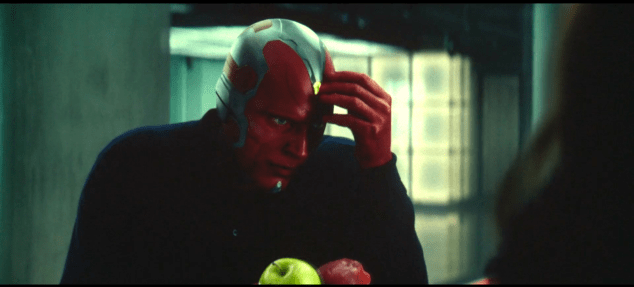
In Marvel’s new Captain America movie, Jarvis, the unintended artificial being, points to the infinity stone dormant inside the center of the top of his forehead.  He explains, “You know, I don’t know what this thing is. I know it’s not of this world…It’s true nature is a mystery, and yet it remains a part of me…I wish to understand it, the more I do, the less it controls me. Who knows, maybe one day I may even control it”. Jarvis describes what Judaism has been describing for thousands of years. The neshama, is the aspect of one’s soul that lies within the brain (Siddur). It is not of this world but rather a “portion of God from above” (Job 30:2). Our task is to master our neshama, to be able to fully integrate it within ourselves. To do this, we have to learn how to direct it, through Torah and Mitzvot, so that we can understand that divine part of ourselves more. And the more we understand it, the less it controls us. Hopefully one day we can fully control it.

To-Feel-In Tune

Screen Shot 2016-06-21 at 11.42.56 AM

The Hebrew word for phylacteries (teffilin) comes from the same root as the word tefilah, which is commonly mistranslated as prayer. The root of the words tefilah and teffilin  creates the verb lehitpalel, which means to change oneself. That is, tefilah and teffilin are both words that describe a person who is in the process of aligning their mind and heart with God by changing themselves; tefilah and teffilin both allow a person to-feel-in tune with God and His creation.

Kabbalah and Listening

listen

In the Amidah, also known as the prayer of the eighteen, there is a verse that says, Vekabel barachim ovratzon et tefilatenu, which translates as “receive with mercy the ratzon of our prayers”.   It’s quite perplexing that verse, because we’re not asking God to listen to our prayer. What we’re asking of God is to kabel, to receive the ratzon or the desire of our prayer.  How does that make any sense? One would think that God would receive our words, that which we express through speech, but we ask God not to focus on our words, but to focus on something called ratzon, which we can translate as will or desire.  Therefore, we’re asking God to access or kabel (receive) the desire and/or the will of our prayers. Why is that significant to Kabbalah?

 There is a story of my Rebbe when he was an adolescent. He is introduced to a Rabbi that he has to learn from. The Rabbi agreed to teach him under one condition: he couldn’t ask why the Rabbi is doing what he is doing.  In other words, whatever it was that my Rebbe saw the Rabbi do could not be questioned. So adamant was the Rabbi about this condition, that if my Rebbe asked, the Rabbi would answer, but my Rebbe could no longer learn from him.  My Rebbe agreed, and he sat and observed the Rabbi interacting with various people about issues they were having with their life.  As more and more people approach the Rabbi with questions, my Rebbe started to get more and more confused.  Question after question came to the Rabbi, and yet he answered none of them. Rather, he gave each and every single person that came up to him advice and help in one form or another that had nothing to do with the question they asked, but people were leaving satisfied.

Eventually, my Rebbe couldn’t take it anymore, and so he finally asked the Rabbi,  thereby forfeiting his opportunity to learn from him anymore.  He asked why the Rabbi was responding to questions in a way that never even addressed the actual question.  The Rabbi responded “A lot of people have questions that have nothing to do with what they really want to ask because they’re uncomfortable asking about the certain situation they’re in”. It was the Rabbi’s responsibility not to be sensitive to their words, but to the desire that lied within their hearts, which they were trying to express in a hidden way through their speech.  In other words, the Rabbi’s role was to be able to kabel ratzon et tefilatenu, to receive the desire (ratzon) of a person’s words, to be sensitive to receiving and processing what they wanted and not just answering a seemingly black and white question in a black and white way.

This is precisely what we ask of God during the prayer of eighteen. We ask Him to be sensitive to that which we desire, even if it means that we can’t express it in words.  And in the same way God has to kabel, to receive our desire in a way that He hears it past our words, we also have to become sensitive to His ratzon, His will, His desire, irrespective of what we see in our life as true, because no matter how we see the world, for the good or bad, it really is an expression of God’s desire to give us an infinite and boundless light and pleasure. Kabbalah is the science through which we can access the ratzon of God, a ratzon of love, a ratzon of unlimited giving, which allows us to look past the superficial world in front of us in order that we access the infinite. Where do we see this? In the shma prayer. It says vehaya im shamo’a tishme’u el mitzvotay asher anochi metzaveh etchem, “If you will listen to my commandments, which I have commanded you”. Why are we instructed just to listen to God’s commandments in the shma? Why doesn’t God tell us to perform or to fulfill? Why listen? It is because every mitzvah is trying to speak to us, it is trying to communicate to us a message for which we have to be sensitive. It is not enough that we perform or fulfill by rote action. Rather, we are challenged with the task of looking past the superficial so we can listen to the voice of Hashem behind every mitzvah, to the point where we can access His ratzon. I challenge any man to listen to his tefillin, to his tzitzis, to his siddur, they have so much so say to you, God has so much to say to you, because there’s so much He wants for you, and with Kabbalah, you and I can begin to access His ration the way He accesses yours. All we have to do is listen.

PhotographerUnknown:http://smallbiztrends.com/wp-content/uploads/2012/11/listen.jpg

What is God?

proof-god-exists1

I can recall conversing with my little brother about the nature of God. I remember asking him, “Daniel, where is God?” He replied rather astutely, “God is in the sky!” I then, to the best of my ability, hid my laughter, and forced a confused demeanor on my face and responded, “But Daniel, I’ve looked outside an airplane and I never saw God…” He cleverly deduced that “God exists at a lower altitude than the altitude at which planes fly.” Then, I challenged him more saying, “I can assure you that if I take a telescope and observe the heavens, God will not be in sight no matter the altitude.” He thought some more and with the utmost clarity he said, “That’s because God is invisible!” I burst out in laughter. One of the greatest joys I have experienced is observing the mind of a young thinker plowing through the depths of his innocent thoughts to uncover a sense of truth. I then asked, “Well if you COULD see God, would He be young or old?” “Old,” he replied. “Fat or skinny?” “Fat,” he replied. “Does he have a beard?” “Yes, he has a white beard,” he said. “Does He know when you’re sleeping?” He screamed, “Of course, Mikey!” “Does he know when you’re awake?” He nodded. To his amusement I finally concluded, “So you think God is Santa?” He burst out in laughter; his eyes showed me he was thinking about the conversation, there was an energy, an electricity that passed through him that showed me an inspired soul.

It’s quite interesting actually, the word “Santa,” as it could be rearranged to spell the word “Satan”. And quite frankly to my knowledge Santa and Satan have similar abilities; they both “Know if you’ve been bad or good”. Perhaps in the same way the word “Santa” is the word “Satan” when rearranged, Satan’s negative role is rearranged as a positive position in the form of Santa. That is to say that Satan’s role is perceived as punishing the bad but not rewarding the good and Santa’s role is rewarding the good and not punishing the bad. Either way they both fall short of what Judaism describes God to be. So how can God be described? There is a famous prayer entitled “Adon Olam” (Master of the Universe) that writes “He was, He is, and He will always be…He is without beginning and without an end…unfathomable”. According to the source, God could not have been created since he has no beginning, and no end would imply that He cannot cease to exist, and He cannot be understood by the human mind since He is unfathomable. Moreover in the Zohar it writes, “No thought is able to grasp you at all” (Tikkuney Zohar). So how can we define something that cannot be described by the human mind? What can we relate this definition of God to that would allow us to come closer to realizing practically what God is? We need to find something we’re familiar with that has the same definition of God, which meets the same conditions God does according to the writings. So what can’t be created, and at the same time cannot cease to exist, but also can’t be fathomed that we know of today?

Well…what does the first law of thermodynamics state? “Energy cannot be created nor destroyed…” How do we define energy? We don’t because we can’t. We can only understand energy in the forms it takes (light, heat, kinetic, potential, electrical etc.), but even that is limited. For instance, we don’t know what electricity looks like, but we know how to use it and manipulate it, but what energy is in and of itself cannot be defined. Where is energy? Everything is energy, because matter in essence is a manifestation of energy in physical form. Energy is the chair I sit on, the shower I take, the feelings I feel, the thoughts I have, and the intimacy I experience. Every second of every day, whether we are conscious of it or not, this web of energy permeates and passes through us, is converted and spreads throughout our bodies, in synapses, mitochondrial and cell membranes, blood vessels, bones, and the list goes on infinitely. Throughout space and time, it is recycled, used, and reused. This vitality that gives us our existence as well as the existence of everything in the universe is the God Judaism speaks of…and not Santa.

Just Kiss Me

tumblr_lb1u780r5t1qajjdco1_500

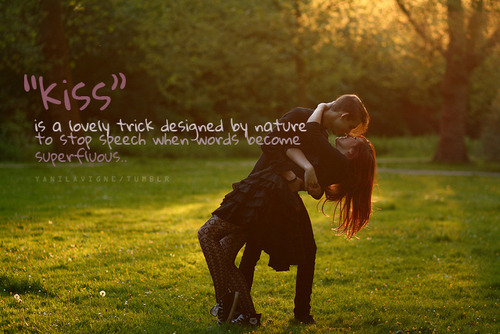
When I think of Torah, I immediately think about the nature of human relationships; you can’t understand one without the other, especially when it comes to prayer and Torah study. Real prayer and Torah study is all about kissing. Why is it that we have the custom to kiss a mezuzah, siddur, and sefer Torah? Why kiss phylacteries and tallis? What’s all this kissing about? It’s about being intimate with what we study, with what we pray, and with what we interact with in our world. How does the Amidah begin? We say “Master, OPEN MY LIPS…” we literally want to start our highest spiritual experience with a kiss. May we all be given the capacity to kiss.

Image Author Unknown: http://30.media.tumblr.com/tumblr_lb1u780r5T1qajjdco1_500.jpg

Precious

853111677_a9ff14f640_o

I practically taught my little brother everything I know, how to read in Hebrew, in English, math skills, language, you name it. Raising a child changes a person from my experience. The bond I share with him is so tight that I worry about the craziest things sometimes. When I’m walking with him outside and he’s two meters away from me, I can’t help but worry what might happen to him. I begin imagining the worst. What would life be like if something happened to him heaven forbid? Just the thought makes me cringe. It’s because he is precious to me, he’s my everything.

Shir Lama’alot is a song composed by King David and he expresses how Hashem shomer Israel (guards the nation of Israel) yishmor et nafshecha (He gaurds their souls) yishmorcha kol ra (he gaurds us from all evil). But Hashem is not the only one who protects. It is our obligation to protect. We have shomer Shabbat (protecting Shabbat) shomer mitzvoth (guarding mitzvoth) shmiras habris (guarding our bris) shmiras halashon (guarding our speech) and so on. Why is shomer so special?

What would you guard in your life? What would you protect? If I make a hundred dollars, I put it in my wallet to protect it. If I make 10,000 dollars, I don’t put it in my wallet, I put it in a safe, because its more valuable, its more precious, I can gain a lot more from it. What happens if I make 50 million dollars? Do I put it in a safe? No, because a safe is not good enough to protect something so precious and valuable. It turns out, that when we are told to guard the Sabbath, the mitzvoth, or anything else, it means that we have to see these things as precious. The more precious something is to us, the more we guard it. There are many people who perform the mitzvoth of Shabbat, and the halachos, but they don’t protect them, they don’t cherish them, its not precious, its something they feel has to be done, like brushing teeth, just a part of life. The same applies to interpersonal relationships. Why is shomer such a huge thing?

Adam was placed in the Garden of Eden to ul’avdah ul’shamrah (to work on it and to protect it). But if you look closely at those words you’ll find that ul’avdah ul’shamrah are in the feminine. Adam’s task was not only to protect the Garden (a garden is referred in Hebrew as a feminine object because it is planted in and produces like a woman), but to also protect his wife, to hold her precious to himself, to never let her go, to see her as the greatest wife in creation, his only wife in creation. What happened in the Garden as we all know? The serpent starts to converse with Eve and talks her into consuming from the Tree of Knowledge. The question is “Where was Adam during this conversation?” He was nowhere near his wife, so he broke one of his first obligations, to hold his wife as precious, he was too distracted by everything else in the Garden. Some Midrashim even say he was asleep during the conversation between Eve and the serpent. And what happens when Adam is confronted by Hashem? Adam says “The wife YOU gave me made me eat” (Genesis 3:12). So not only does Adam blame his wife, not only does he not protect her and hold her precious when being confronted by God, but he blames Hashem for having given Eve (talk about ungrateful). Can you imagine the look on Eve’s face when she’s being scapegoated, the horror and the anguish of being taken for granted by her partner in the world, her other half? It reminds me of the many women who sit quiet in anguish today in the face of an unappreciative husband and vice versa.

But despite Adam’s mistake, despite his destructive nature, Hashem held him precious, and He held Eve precious, because they were His everything. In Hashem’s love for them something new was born, a gift, Shabbas, but specifically shomer shabbas; He gave them a chance to hold each other precious again, a chance to frolic in the Garden once more. The biggest error we can make as a nation is to not hold one another as precious, that’s the reason why the Beis Hamikdash was destroyed and it is unconditional love, a state of holding each other as precious in one another’s eyes, that will bring the third and final Temple. So how can we be more shomer?

The first step is to ask “Do I shomer myself? Am I precious to myself? Do I treat me in a way that expresses my self appreciation, or do I just do things for me out of obligation? What is one tiny thing I can do for me to genuinely express my self appreciation?” The next step is “Do I shomer others? Who do I hold precious to me? Do I treat them in a way that expresses my appreciation for them or do I just do things for them because I have to? What tiny thing can I do for each of them that genuinely expresses my appreciation for each of them?” The final step (if this applies to you) is “Do I shomer Hashem? Do I hold God as precious? How do I perform the mitzvoth in a way that expresses my love of God without just doing mitzvoth out of a sense of obligation? What tiny thing can I do that will express my love for God?” None of these questions require a revolutionary change, just a small positive step forward.

May Hashem, despite our flaws as a nation, constantly guard us from all evil and may Am Yisroel and the world always be His everything.
Where are You?

Where-Are-You-Note-on-Map-Backgrond

I was six years old when I experienced my very first “Where are you?” (WAY) moment. It was scary. Picture your first ever papercut, so irritating. You take a band aid and you wrap it around  your finger; you feel a gentle  pulsating sensation  on the area around which the band aid is wrapped. That’s what my first WAY moment felt like, an almost imaginary pulse centered within my very soul. It was a thought that pecked at my mind,  a question of “Why am I here?” “What’s this life for?” Why am I specifically looking at this world through my eyes? What does it feel like to see the world through someone else’s eyes? The pulsating feeling revisited me often and to this day.

Just one hour after he is put in the Garden, Adam eats from the Tree of Knowledge of Good and Evil and disconnects from God. It’s at this moment in time that Adam realizes his state of “nakedness,” so he did what anyone in his position would do, he “hid”. And Hashem calls out to Adam asking him “Where are you?” But it’s  not because God didn’t know Adam’s location in the Garden. God was asking Adam to ask himself “Where are you?” In other words, “What is your position, your role in My creation? Ask yourself this question.” That’s why Adam hid in the bushes, because he was scared of not having a purpose in life, and he was even more terrified of looking for the answer.

But WAY moments aren’t just centered around asking what the purpose of my life is, in the same way that Adam’s struggle was not only trying to determine his purpose. Adam was also broken because he felt like Hashem left him. There is a famous Psalm that we sing during times of mourning and distress called “al tashlicheni”. We pray that Hashem doesn’t leave us at a time of old age. Old age doesn’t only refer to a moment of seniority. It describes moments where I feel like things get old, when life gets old, it is a point where we ask ourselves “Where are you?” it is a point where we feel like we’re lost.

The sensation of being lost wasn’t specific to Adam, it’s something that repeats itself throughout the TANACH, whether it is Jacob’s loss of Joseph or Job losing everything that meant something to him in his life. And that WAY moment pecks at our minds even today, when we feel lost, as if Hashem has turned His back on us and left.

And there was perhaps no worse feeling of Hashem leaving the nation of  Israel as in the time of the ruining of the Second Temple, a temple that was destroyed on the basis of the baseless hatred the people of Israel had for one another. But according to the Tikkuney Zohar, Hashem never left. He says “‘You have thought that from the day the Temple was destroyed that I have entered My (heavenly) house and dwelt there, but this is not so! I have not entered it at all! For as long as you are in exile, you have a sign: My head is full of dew’” . In other words God is telling them “I never left you and I never will, unless you come with Me”. Jacob thought he lost his son Joseph, but then realized 22 years later that Hashem didn’t forsake him. Job was given twice his lot compared to his initial lifestyle. Even Adam was given another chance to enter the Garden. And I think that the only reason why the nation of Israel felt like Hashem turned His back on them is because they turned their backs on one another, but more deeply, they turned their backs on themselves, to whom each of them truly was.

This Yom Kippur we ask Hashem “Where are You?” And He answers “I was always here, I never left, I will never leave.” Then He asks us “Where are you?” And then we face ourselves with the same question and then turn to each other in happiness and joy to embrace one another. Finally we apologize not for the mistakes we’ve made, but for having moments where we lost sight of how special we are. I hope this next year is filled with pulses that beat with joy, that we should be able forgive each other, and ourselves.

The Compliment Game: A Rosh Hashanah Special

I love my mother. A sea full of words could not describe how much she means to me; her self-sacrifice, courage, and strength are mere words that couldn’t possibly clothe the inner depths of my appreciation. So I decided one day to sit her down and play a game. I looked into her eyes and told her how much she means to me. I told her that the way she ran things at home reminded me of how Hashem runs the world: discretely, subtly, but with the utmost care and precision. As I described how I felt, I got all choked up…tears ran down my face. I looked into her eyes and finally said, “I wish I could be like you, thank you for everything. I love you mommy”. She cried…WE cried, and I lit a candle to celebrate the special moment. All it took was a compliment, a sincere ‘thank you’, a warm ‘I love you’.

I always try to look at Rosh Hashanah in a different way every year. This year (or should I say next year) I look at Rosh Hashanah through looking, literally. I see it as an opportunity to look into the eyes of those people I love the most, to appreciate them in a way I never expressed previously. I then look inward and focus on everything I love about myself, how I’ve grown, how much more special I have become compared to the previous year. Finally, I gaze at Hashem and thank Him for loving me. I focus on the things He helped me with, the struggles He gifted me with and I look forward into the future, at the infinite possibilities that await me. And what better way than to appreciate His partner, my mother—my creator—who gave birth to me in this world

And the funny thing is that Rosh Hashanah begins with the birth of Adam HaRishon. Why is that so special? Rabbi Nachman of Breslov explains in his Likutey Moharan that the name Adam describes a person who strives to know the essence of his/her existence. And so on Rosh Hashanah, we look back at what was, where we came from, the purpose for which we were made, so we can strive to reach what we can be. We examine our beauty and strive to be more beautiful, our strengths so we become stronger, our limitations so we can love ourselves despite them.

Let’s celebrate this Rosh Hashanah, the moment of the creation of reality itself, by being like the Creator, a quality of boundless love; He loves us more than we could possibly love ourselves. And He wants us to be like Him; He wants us to see ourselves the way He sees us. I hope that we will all be given eyes to see.

Shanah Tova

Mistakes: The Engine of Change

I always look back at the story of creation, a story where the perfect human being was created, a being who ruined everything for himself and his wife. And the general masses tend to think that Adam’s mistake was eating from the Tree of Knowledge of Good and Evil, and they tend to blame his wife for his misfortune. First off, I think this idea of Adam being the victim of his wife’s mistake is culturally one of the reasons why women have been treated with such disrespect over time and to this day. The masculine supremacy that tends to be abused nowadays has a biblical root, and it comes from the beginning, literally.

But it’s clear in the literal text, that Adam was not punished because he ate from the Tree. When he is confronted by Hashem, he blames his wife for his mistake and Hashem doesn’t punish him for eating from the tree, he punishes him for something else, for listening to his wife (Genesis 3:17). But more importantly, God punishes him for not owning up to his mistake, for using his wife as a scapegoat, for threatening the connection between him and his wife for his selfish need to be accepted by Hashem. But Adam’s mistake was EVEN deeper than that.

Adam was under the impression that there was something wrong with being imperfect, he thought that Hashem would love him less because of what he did. It was Adam’s insecurity, his lack in the love he had for himself that caused him to play the “blame game”. God was never really mad at him, because He gave him another chance to enter Eden on Shabbat. He wanted Adam to realize that making a mistake only meant something if you let it get to your head.

One of the greatest errors is to think that there’s something wrong with having a little bit of ugly in us. It’s been put there for a reason. It’s written “I have created the evil inclination; I have created the Torah as its spice [remedy].” (Kiddushin 30b). The reason why we have ugly in us, the reason why we make mistakes, is because we’ve been made that way, it’s our nature. It would be boring to be perfect; where’s the spice in that? Moreover, many Torah Scholars agree that Adam had to sin, that it was preordained for him to make a mistake. The test was: could he be himself regardless?

I can’t BEGIN to describe how many people say we live in a lowly generation, that we’ve been corrupted, that we’re no good. And we’re just reliving that past, we’re making Adam’s mistake again. And the whole idea is to disconnect from that, to realize that we’re the same souls of all the previous generations. The biggest change is to love ourselves despite our limitations. The term “Love thy friend as thyself” is not a commandment, it’s who we REALLY are, and we can’t love others if we don’t love ourselves first.